
Arabic and English in one conversation: how AI support handles dialects, code-switching and customer language preference
Customers in the Gulf don't choose one language and stay in it.
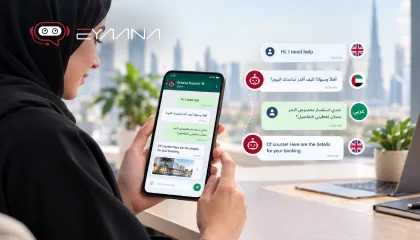
Customers in the Gulf don't choose one language and stay in it. A message might start in English, drop in an Arabic phrase, continue in Arabic written with Latin letters, and end with an emoji. An AI support system that treats language as a setting chosen once at the start of a chat will misread a large share of real conversations, and the customers it misreads rarely complain. They simply leave.
Where multilingual AI struggles
Dialect variation. Modern Standard Arabic is formal and rarely how people actually type to a business. Gulf, Levantine, Egyptian and North African dialects differ in vocabulary, spelling and phrasing, and a model trained mainly on formal text can miss the meaning of an ordinary message. The same word can carry different connotations from one country to the next.
Code-switching. Mixing languages within a single sentence is completely normal for many customers in the region. Systems that detect one language per message get confused, and systems that force a single language per conversation feel stiff and unnatural.
Arabizi. Arabic written in Latin characters, often with numerals standing in for letters, is common in chat and hard for systems built around either script. A customer typing in Arabizi is not being careless. It is simply how they communicate.
Right-to-left layout and formatting. Buttons, cards and templates that look fine in English can break when text flows right to left, with misplaced punctuation, reversed numbers and clipped labels. This needs testing in the actual channel.
Names, numbers and addresses. Transliteration varies, order of components differs, and a booking system that can't match "Mohammed," "Muhammad" and "محمد" creates duplicate records and frustrated customers.
What good looks like
Detect language per message, not per conversation, and reply in the language the customer last used, unless they say otherwise. If a customer switches to English for a technical term, the reply should follow naturally rather than correcting them.
Respect stated preference. If a customer says "English please," honour that for the rest of the conversation and remember it next time. Preference stated explicitly should always override detection.
Test on real transcripts from your own customers, in the dialects they actually use, rather than on clean sample sentences. Your own chat history is the best test set you have.
Keep tone appropriate. Formality, honorifics and greetings differ by language and context, and a literal translation can sound cold or oddly stiff. A greeting that feels warm in Arabic may need rethinking in English, and vice versa.
Route when confidence is low. If the system isn't sure it understood, it should ask a short clarifying question or bring in a human who speaks that dialect. A confident wrong answer is worse than a quick check.
Use one knowledge base, not two. Maintaining separate Arabic and English answers means they drift apart and eventually contradict each other. A single source of truth, expressed in whichever language the customer uses, keeps policy, pricing and availability consistent.
Why it matters commercially
Language friction is a quiet cause of abandoned chats and repeat contacts. Customers who feel understood in their own way of speaking stay in the conversation, and in sectors like hospitality, real estate and retail the first reply often decides the sale. For voice, the same principles apply with the added challenge of accents and speech recognition, which makes testing with real recordings even more important.
Measure the experience
Track resolution rate and handoff rate by language, and compare them. A sharp gap between Arabic and English outcomes is a signal that the system is underperforming for part of your audience, and it points to exactly where to improve.
Why choose Eyaana
Eyaana supports Arabic and English across chat, voice and messaging channels, detecting language as the conversation moves and drawing on a single knowledge base so answers stay consistent. When a conversation needs a native speaker or a judgment call, human agents can step in with full context, so customers never have to repeat themselves in either language.
Eyaana is an AI customer support platform designed for customers who switch between Arabic and English mid-conversation.